


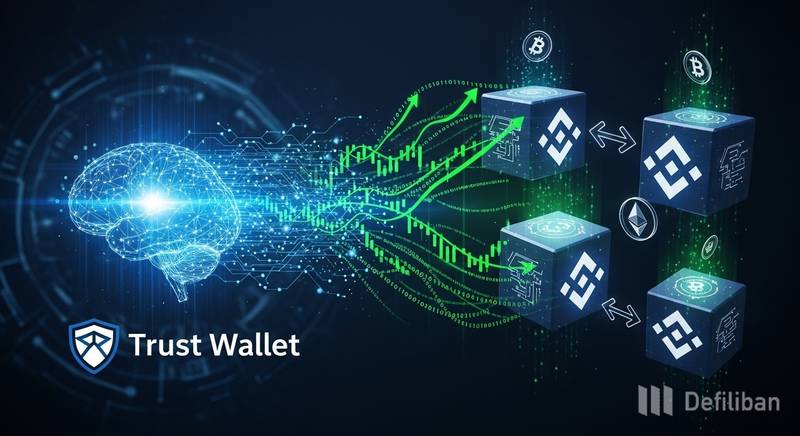
Trust Wallet, the self-custody crypto wallet owned by Binance with a reported 220 million users worldwide, has begun offering AI-powered trading agents directly within its app. The rollout, first reported by Forbes, positions Trust Wallet as one of the largest crypto platforms to embed autonomous trading intelligence at the wallet level.
Trust Wallet Global Users
220M
Binance-owned Trust Wallet now offers AI crypto trading agents to its 220 million users worldwide. Source: Forbes
What Trust Wallet’s AI Trading Agents Actually Do
AI trading agents in crypto wallets are software programs that can execute trading actions autonomously on behalf of users. Unlike simple trading bots that follow rigid if-then rules, AI agents use machine learning to interpret market conditions, adjust strategies, and carry out multi-step operations without constant manual input.
In the context of a self-custody wallet like Trust Wallet, these agents can handle tasks such as token swaps, portfolio rebalancing, and dollar-cost averaging execution, all without requiring users to transfer funds to a centralized exchange. The key distinction is that assets remain in the user’s own wallet throughout the process.
Autonomous Agents vs. Simple Bot Scripts
Traditional crypto bots operate on predefined parameters: buy when price hits X, sell when it hits Y. AI agents go further by analyzing multiple data inputs, adapting to changing conditions, and chaining actions together. A bot executes a single instruction; an agent can assess a portfolio, identify an imbalance, find the optimal swap route, and execute the trade in sequence.
For Trust Wallet users, the practical difference is accessibility. Strategies that previously required custom scripts, API integrations, or third-party platforms can now run natively inside the wallet interface. The feature effectively brings quantitative trading tools to retail users who may have no coding experience.
Why 220 Million Users Changes the AI-Agent Calculus
Trust Wallet’s 220 million user base makes this one of the largest deployments of AI trading tools in retail crypto. For comparison, most standalone wallet providers operate with user bases a fraction of that size. The scale transforms what might otherwise be a niche feature into a mainstream product category shift.
The timing aligns with a broader industry race to embed AI capabilities into crypto infrastructure. Coinbase recently debuted wallet infrastructure specifically designed for AI agents, while centralized exchanges have been rolling out their own AI-assisted trading features. Trust Wallet’s move signals that the competition has expanded from exchanges to self-custody wallets, a development that could also affect how protocols like TON approach their own infrastructure upgrades.
For TWT, Trust Wallet’s native token, the integration introduces a potential new layer of utility. If AI agent features require TWT for gas fees, premium tiers, or governance participation, the expanded functionality could influence token demand. However, specific tokenomics details around the AI agent rollout have not been publicly confirmed.
Lowering the Barrier for Non-Technical Traders
The core accessibility argument is straightforward: most retail crypto holders do not have the technical skills to deploy trading algorithms. They hold tokens in wallets and trade manually, often reacting to market moves rather than executing systematic strategies.
AI agents embedded directly in Trust Wallet eliminate the need for external tools, API keys, or programming knowledge. A user who previously could only buy and hold can now set up automated rebalancing or DCA strategies through the same interface they use to send and receive crypto.
Risks remain, however. Autonomous agents operating in volatile crypto markets can amplify losses if strategies misfire. Smart contract interactions introduce additional exposure, and agent errors in a self-custody environment have no exchange-side safety net. Users retain full responsibility for any trades their agents execute, a reality that legal experts say creates a new frontier for crypto wallet liability, as highlighted by a recent Electric Capital analysis.
Trust Wallet, Binance, and the Push Toward Autonomous Crypto
Trust Wallet was acquired by Binance in 2018 and has since operated as a semi-independent brand within the Binance ecosystem. While Binance provides backing and integration points, Trust Wallet maintains its own development roadmap focused on self-custody and multi-chain support. The wallet supports over 100 blockchains and has built its user base partly through its association with the world’s largest crypto exchange.
The AI agent launch fits within Binance’s broader push into AI and Web3 tooling. BNB Chain has been developing its own agent infrastructure, and Binance has signaled interest in AI-powered features across its product suite. Trust Wallet’s integration represents the self-custody arm of that strategy, bringing AI capabilities to users who prefer holding their own keys over using centralized platforms. In the broader market, events like the revived Nvidia crypto fraud lawsuit underscore how quickly the regulatory landscape around emerging crypto technologies can shift.
Looking ahead, expanded agent capabilities could include cross-chain operations, support for additional asset classes, and more sophisticated strategy templates. The infrastructure for native prediction markets already built on Trust Wallet suggests the platform is positioning itself as more than a simple wallet, evolving into a full execution layer for autonomous crypto activity.
Industry First
Trust Wallet becomes the largest crypto wallet by users to embed native AI trading agents
220 million users · Binance-owned · Reported by Forbes · March 2026
Whether Trust Wallet’s 220 million users adopt AI agents at scale will depend on execution: intuitive interfaces, reliable performance, and transparent risk disclosures. The infrastructure is now in place. The adoption question shifts from “can retail traders access AI agents?” to “will they trust them with real capital?”
Disclaimer: This article is for informational purposes only and does not constitute financial or investment advice. Cryptocurrency and digital asset markets carry significant risk. Always do your own research before making decisions.