


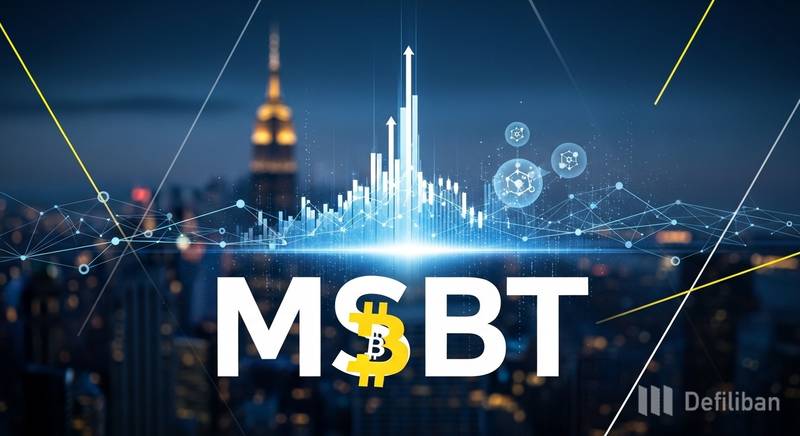
Bloomberg senior ETF analyst Eric Balchunas says Morgan Stanley’s spot Bitcoin ETF, trading under the ticker MSBT, received an official listing announcement from NYSE Arca, a signal he describes as meaning “launch imminent.” If approved, MSBT would become the first spot Bitcoin ETF issued directly by a major U.S. bank, a distinction that could redirect institutional BTC capital away from DeFi’s wBTC liquidity pools and reshape collateral dynamics across lending protocols.
Eric Balchunas Flags MSBT: Why This Signal Matters
Balchunas, whose Bloomberg Intelligence ETF team accurately called the January 2024 spot BTC ETF approval wave including BlackRock’s IBIT and Fidelity’s FBTC, flagged the MSBT listing announcement as a significant milestone.
“Morgan Stanley Bitcoin ETF $MSBT got an official listing announcement from NYSE, that typically means launch imminent.”
Eric Balchunas, Senior ETF Analyst, Bloomberg
Analyst Spotlight
MSBT
Morgan Stanley Spot Bitcoin ETF — proposed ticker
“This is a major bank putting its name on a spot BTC product — that matters.” — Eric Balchunas, Senior ETF Analyst, Bloomberg
The filing trail backs up the urgency. Morgan Stanley submitted its original S-1 registration to the SEC on January 6, 2026, followed by an amended S-1 on March 18 and a Form 8-A for NYSE Arca listing on March 25. The Form 8-A is the final administrative step before shares can trade on the exchange.
MSBT’s anticipated management fee of 0.24% would undercut BlackRock’s IBIT at 0.25%, positioning Morgan Stanley competitively in a market where U.S. spot Bitcoin ETFs collectively hold over $100 billion in assets. Fidelity serves as the Bitcoin custodian for MSBT, while BNY Mellon handles cash custody and administrative services.
Market Context
$100B+
Combined AUM across U.S. spot Bitcoin ETFs
Since SEC approval in January 2024, spot BTC ETFs have attracted over $100 billion in assets, making Morgan Stanley’s MSBT entry into a proven, high-demand category.
What separates MSBT from every existing spot BTC ETF is the issuer. BlackRock, Fidelity, and other current providers are asset managers. Morgan Stanley is a bank, one whose wealth management arm already recommends up to 4% Bitcoin allocation for suitable clients across more than 15,000 financial advisors. A 2% allocation across Morgan Stanley’s client base alone could route an estimated $160 billion into MSBT.
The SEC has not yet granted final approval. The review is ongoing, with a ruling expected between late Q2 and early Q3 2026. The initial basket size is set at 10,000 shares, with seed capital of approximately $1 million.
MSBT Approval Could Drain wBTC Supply and Reshape DeFi Lending Markets
For DeFi, the more pressing question is not whether MSBT launches, but where the Bitcoin it absorbs comes from. Institutional capital that might otherwise flow into on-chain wBTC positions now has a regulated, bank-branded alternative with lower friction and familiar custody infrastructure.
The precedent is clear. When BlackRock’s IBIT launched in January 2024, wBTC supply growth plateaued. Institutional allocators who previously needed wBTC as their only regulated-adjacent Bitcoin exposure in DeFi had a simpler option: buy the ETF, hold with a qualified custodian, skip the smart contract risk.
This dynamic creates a structural liquidity shift. ETF custody through providers like Fidelity and Coinbase Prime operates in a completely separate layer from on-chain wBTC, which relies on BitGo custody and a mint/burn mechanism. Every dollar of institutional BTC demand that flows into MSBT is a dollar that does not enter DeFi as wBTC collateral.
The downstream effects hit lending protocols directly. wBTC is one of the largest collateral assets on Aave V3 and a significant component of MakerDAO/Sky vaults. If wBTC supply contracts or growth stalls while ETF products continue absorbing institutional demand, protocols face thinner collateral pools and potential liquidity fragmentation.
Morgan Stanley’s distribution advantage amplifies this risk. With over 15,000 financial advisors already cleared to recommend Bitcoin exposure, MSBT provides a direct on-ramp that competes with wBTC for the same pool of institutional capital, but without requiring clients to interact with DeFi infrastructure at all.
What DeFi Protocols Should Watch: Governance Responses and cbBTC as the Alternative
DeFi governance bodies are already navigating BTC collateral questions. Aave governance forums have discussed adjusting wBTC loan-to-value parameters following concerns about BitGo custody changes in late 2024. If MSBT’s launch further pressures wBTC supply, similar parameter reviews could accelerate.
Coinbase’s cbBTC, launched in late 2024, presents an interesting counterbalance. Because Coinbase Prime serves as custodian for both BlackRock’s IBIT and cbBTC itself, there is a shared infrastructure layer between ETF custody and on-chain wrapped Bitcoin. This positions cbBTC as potentially more aligned with the institutional flows that MSBT represents than wBTC’s BitGo-based model.
MakerDAO/Sky governance has already explored BTC collateral diversification beyond wBTC. If cbBTC continues to gain TVL share relative to wBTC, protocols may need to rebalance their collateral frameworks to reflect where institutional BTC actually lives on-chain.
The net effect on total BTC locked in DeFi depends on how much new institutional demand MSBT creates versus how much it redirects. If Morgan Stanley’s ETF primarily captures capital that would never have entered DeFi regardless, the impact on wBTC supply is muted. But if it pulls capital that currently sits in wBTC-collateralized positions on Aave or Spark, protocol collateral depth shrinks.
Bitcoin traded near $71,674 at the time of the MSBT filing, with a market cap of approximately $1.39 trillion. The SEC is currently reviewing 126 crypto-related filings, with MSBT’s final ruling expected no earlier than late Q2 2026. DeFi governance teams tracking BTC collateral exposure should monitor the SEC docket and any shifts in ETF flow patterns as the approval timeline narrows.
Disclaimer: This article is for informational purposes only and does not constitute financial or investment advice. Cryptocurrency and digital asset markets carry significant risk. Always do your own research before making decisions.