


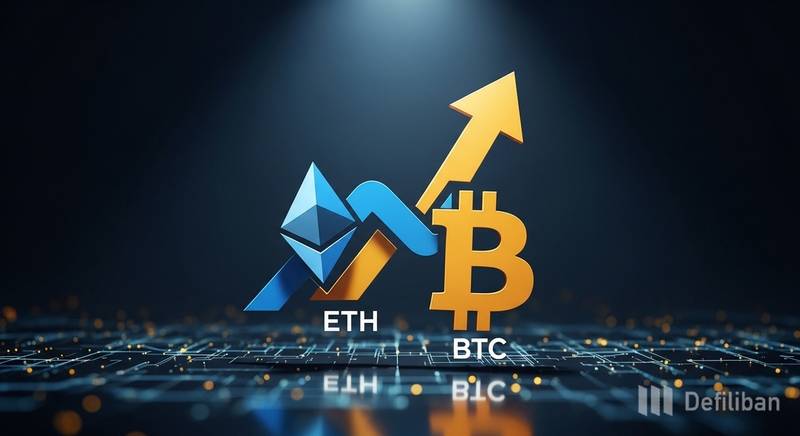
Machi ETH and BTC longs are back in focus after a secondary market report said the whale trader increased a 25x ETH long and opened a 40x BTC long as both assets moved higher. The setup matters less as a clean market catalyst than as a read on risk appetite, because the underlying wallet snapshot and original tracker post were not directly readable in this environment.
A Blockchain.News flash report citing Lookonchain said Machi Big Brother scaled long exposure to 21,900 ETH at 25x leverage and opened a separate 50 BTC long at 40x. That report put combined notional exposure at about $105.9 million, which is large enough to draw attention even in a fast-moving majors market.
TLDR Keypoints
- Secondary reporting attributed to Lookonchain said Machi increased a 21,900 ETH long at 25x and opened a 50 BTC long at 40x.
- The same report estimated combined exposure near $105.9 million while ETH and BTC were both rallying.
- The original post and a live wallet snapshot were not directly readable here, so the position data should be treated as reported, not fully confirmed.
What the market reports say about Machi’s leveraged ETH and BTC bets
The available evidence supports a cautious framing. The core numbers, 21,900 ETH, 50 BTC, and roughly $105.9 million in exposure, come from a secondary market summary rather than a directly verifiable exchange or explorer snapshot. That is why “reportedly” is the right word for this story.
That distinction matters because crypto whale reports often move faster than primary verification. A post from a tracker account can be accurate, stale, partially updated, or already superseded by later position changes, and readers cannot evaluate that risk if the original post and wallet view are inaccessible.
For DeFi and derivatives traders, the more defensible takeaway is not that one whale “called” the market. It is that highly levered directional positioning is once again part of the conversation as majors rebound, which tends to affect funding expectations, liquidation maps, and short-term sentiment across perpetual venues.
Why traders connect whale leverage to the current ETH and BTC rally
The timing of the reported trade helps explain the attention. In the same research window, ETH traded at $2,353.57, up 8.3% in 24 hours, while BTC traded at $75,172.57, up 3.6% over the same period.
When price acceleration lines up with visible whale leverage, market participants tend to read it as a sign that risk capital is willing to press momentum rather than fade it. That does not prove a durable trend, but it does help explain why these reports travel quickly through crypto trading circles.
ETH market context
ETH’s reported move was the sharper one. An 8.3% daily gain on a market with about $284.2 billion in market capitalization and roughly $39.7 billion in 24-hour volume gives any large leveraged long immediate narrative force.
If the 21,900 ETH figure is accurate, the position represents exposure to a sizable chunk of ETH notional during an already volatile session. In practical terms, that is the sort of trade that can amplify momentum psychology in the same way ETF flow headlines or prediction-market swings do, because traders start anchoring on what a known whale appears willing to risk.
For ETH specifically, leverage matters because the asset often carries the spillover effect of broader crypto beta plus ecosystem-specific demand. When traders see aggressive ETH longs during a rebound, they tend to interpret it as a bet on liquidity improving across the stack, not just a one-off price scalp.
BTC market context
The BTC leg looks smaller in size but more aggressive in leverage terms. A 50 BTC long at 40x means a much tighter margin for error than the ETH trade, even with BTC’s lower daily percentage move.
Using simple leverage math, a 25x position can be wiped out by roughly a 4% move against it before fees and execution slippage. At 40x, the buffer drops to about 2.5%, which means even a routine BTC reversal can turn a high-conviction long into a forced exit.
That is why traders monitor these whale reports as risk-appetite signals rather than as pure alpha. A large participant taking 40x BTC exposure while the market is moving higher tells you sentiment has become more aggressive; it does not tell you the trade will survive the next volatility pocket.
What this setup says about leverage risk if momentum fades
The strongest differentiator in this story is not the size of the reported bet. It is the reminder that whale-watch content is most useful when paired with a sober view of liquidation mechanics and source quality.
Liquidation risk is the real headline
Later coverage from Coin Edition said Machi was fully liquidated on a separate 25x ETH long in late February 2026, with losses reported near $29 million. That does not confirm the August 15, 2025 setup directly, but it does show why the market continues to watch this trading style with a mix of fascination and caution.
Another secondary market summary, citing Onchain Lens, described Machi as continuing to open new positions with maximum leverage despite prior losses. Whether that persistence reflects conviction, risk tolerance, or simple headline value, it reinforces the core point: copy-trading extreme leverage is structurally different from observing it.
For readers who trade perps, the lesson is mechanical. High leverage compresses the distance between a profitable trend-following trade and an involuntary liquidation, especially when both ETH and BTC are already extended after a sharp move.
Why unverified wallet data changes the interpretation
The missing piece in this article is direct confirmation. The research brief explicitly notes that the original Lookonchain or Onchain Lens post was not readable here, and no live Hyperliquid, Hypurrscan, or CoinMarketMan wallet snapshot was available to verify balances, entry levels, profit and loss, or liquidation prices.
That means readers should treat the reported position as a sentiment datapoint, not a settled fact pattern. Without primary visibility into the live account, there is no way to know whether the position was still open, partially reduced, hedged elsewhere, or already moving toward liquidation when the report circulated.
This is where market structure matters more than social virality. Whale posts can shape short-term trader behavior, but absent primary verification they are still one layer removed from the actual venue state, and that gap is wide enough to change the entire trading interpretation.
Why the broader market still watches trades like this
Whale positioning stories persist because they condense several market questions into one screenshot-friendly claim: Is momentum real, are large players adding risk, and could liquidations accelerate the next move? Even partial answers to those questions can move attention, especially when BTC and ETH are already leading the tape.
That also explains why adjacent themes keep resurfacing across crypto coverage, from stronger BTC upside odds to ETF-flow narratives and funding-driven momentum trades. A reported whale long does not replace those broader signals, but it can fit neatly into the same risk-on framework when the market is already looking for confirmation.
The narrow conclusion supported by the evidence is simple. Machi’s ETH and BTC longs were reported at a scale large enough to matter for trader sentiment, but the absence of a readable original post and live wallet snapshot means the setup should be viewed as a speculative whale-watch story, not as a verified market trigger. In a leveraged market, risk management and source verification are more durable signals than any single whale headline.
Disclaimer: This article is for informational purposes only and does not constitute investment advice. Crypto markets and leveraged derivatives carry a high risk of loss, and reported whale positions may change quickly or be inaccurately represented in secondary coverage.
Disclaimer: This article is for informational purposes only and does not constitute financial or investment advice. Cryptocurrency and digital asset markets carry significant risk. Always do your own research before making decisions.