


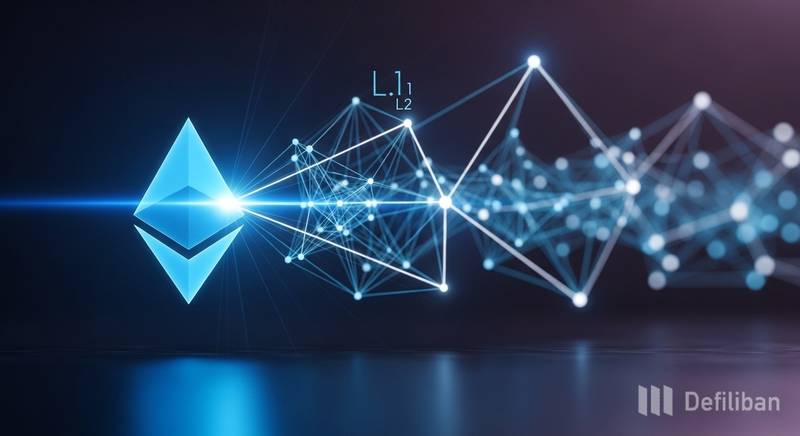
The Ethereum Foundation has published a sweeping protocol priorities update for 2026, reorganizing its entire development roadmap into three tracks designed to scale the L1, unify the L2 ecosystem, and harden the network against emerging threats. For DeFi protocols and liquidity providers operating across Ethereum’s fragmented layer stack, the implications are concrete and immediate.
The Protocol Priorities Update, published February 18, 2026, defines three tracks: Scale (led by Ansgar Dietrichs, Marius van der Wijden, and Raúl Kripalani), Improve UX (led by Barnabé Monnot and Matt Garnett), and Harden the L1 (led by Fredrik Svantes, Parithosh Jayanthi, and Thomas Thiery). Two hard forks are scheduled for the year: Glamsterdam in H1 and Hegotá in H2.
Ethereum Gas Limit — Scaling Roadmap
Source: Ethereum Foundation Protocol Priorities Update 2026
What Blob Throughput and L1 Upgrades Mean for DeFi Infrastructure
Ethereum’s gas limit doubled from 30 million to 60 million in 2025, the first increase since 2021. The Scale track now targets gas limits “toward and beyond 100 million” through the Glamsterdam upgrade, which bundles Enshrined Proposer-Builder Separation (ePBS), Block Access Lists for parallel execution, and blob fee repricing.
For DeFi protocols, the throughput gains are not abstract. Higher gas limits directly reduce execution costs for AMM swaps, lending protocol liquidations, and derivatives settlement. On-chain order books, which have historically been unviable on Ethereum L1 due to gas overhead, move closer to feasibility as the cost per state access drops.
Parallel execution via ePBS and Block Access Lists changes the MEV landscape. Liquidation bots and arbitrage searchers currently compete in sequential block space; parallel execution could reduce the gas premium that MEV actors pay, lowering the effective “MEV tax” on DeFi users. It also shifts sequencer economics on L2s, where blob fee repricing from Glamsterdam will alter the cost basis for rollup operators posting data back to L1.
The Fusaka upgrade in December 2025 already delivered PeerDAS to mainnet, enabling an 8x theoretical blob capacity increase. Combined with Pectra’s doubled blob throughput earlier that year, L2 transaction costs have compressed significantly. This matters for DeFi protocols that deploy across multiple layers, as the spread between L1 and L2 execution costs shapes where liquidity gravitates.
ETH currently trades at approximately $2,177, with a market cap around $281 billion. The Crypto Fear & Greed Index sits at 33, reflecting broad market caution, a sentiment backdrop that echoes the DeFi liquidity pullbacks observed during geopolitical shocks earlier this year.
L2 Ecosystem Vision: Coordinated Scaling or Accelerating Liquidity Fragmentation?
The EF simultaneously announced a new Platform Team with a stated mission to “deliver the strongest possible Ethereum platform, where L1 and L2s are best positioned to support users, apps, and all organizations building on Ethereum.” This is the EF’s most explicit organizational commitment to treating L1 and L2 as a unified platform rather than independent ecosystems.
Two components of the Improve UX track carry direct implications for cross-L2 DeFi. The Open Intents Framework aims to enable trust-minimized cross-L2 interactions, functioning as a coordination layer for transactions that currently require third-party bridges. The Ethereum Interoperability Layer (EIL) is described as a trustless transport layer for cross-L2 transactions.
The core tension for DeFi protocols is whether this vision encourages or discourages liquidity consolidation. Today, TVL is distributed across Ethereum L1, Arbitrum, Base, Optimism, Linea, and a growing tail of application-specific rollups. Each deployment fragments LP capital, dilutes order book depth, and creates slippage differentials across venues.
A trustless interoperability layer could partially resolve this by enabling atomic or near-atomic cross-L2 swaps without requiring LPs to split capital across chains. But the EF’s approach preserves L2 sovereignty, meaning individual rollups retain control over sequencing, fee structures, and upgrade schedules. For protocols like DEXs expanding across multiple chains, this means continued infrastructure overhead to maintain deployments on sovereign L2s even as interoperability improves.
The Hegotá upgrade in H2 2026 advances native account abstraction, making smart contract wallets the default without requiring bundlers or gas overhead. This removes a major friction point for DeFi onboarding, particularly for protocols that rely on complex multi-step transactions like leveraged yield strategies or cross-collateralized lending.
How DeFi Protocols Should Position Across L1 and L2
The EF’s three-track roadmap creates a clear sequencing for protocol teams. Glamsterdam in H1 2026 delivers scaling and parallel execution; Hegotá in H2 delivers UX improvements and security hardening. Protocols planning multi-chain deployments should treat Glamsterdam as the inflection point for reassessing L1 viability for gas-intensive operations.
The post-quantum security initiative, backed by a formally established research team, signals that the EF is preparing for a future migration to quantum-resistant signature algorithms. DeFi protocols with long-lived smart contracts, particularly lending protocols and DAOs with multi-year governance timelocks, should begin tracking this workstream. A quantum-resistant migration could require contract upgrades or redeployments.
Censorship resistance improvements via FOCIL (included in Hegotá) address a risk that DeFi protocols have largely ignored: the possibility that validators could be compelled to censor specific transactions. For protocols handling large liquidations or governance votes, censorship resistance at the L1 level is a security property, not a philosophical preference.
The pattern emerging from the EF’s roadmap mirrors what on-chain activity surges across networks have demonstrated: base layer capacity and cost directly determine where protocol activity concentrates. Historical precedent supports this. After the Dencun upgrade delivered EIP-4844 in 2024, Base saw a rapid TVL surge as L2 transaction costs cratered, pulling liquidity away from L1-native protocols.
Ethereum 2026 Hard Fork Schedule
- Parallel execution (ePBS)
- Higher gas limits
- Blob fee repricing
- Block Access Lists
- Native account abstraction
- Censorship resistance (FOCIL)
- Post-quantum readiness
- Network resilience
Source: Ethereum Foundation Protocol Priorities Update 2026
The next concrete milestone to watch is the Glamsterdam upgrade timeline. If it ships on schedule in H1 2026, expect a repricing of L1 DeFi viability as gas costs drop and parallel execution enables new protocol designs. Protocols that have retreated entirely to L2s may find compelling reasons to maintain or restore L1 deployments, while L2-native protocols will need to evaluate whether the Open Intents Framework and EIL reduce the capital inefficiency of fragmented liquidity pools.
Disclaimer: This article is for informational purposes only and does not constitute financial or investment advice. Cryptocurrency and digital asset markets carry significant risk. Always do your own research before making decisions.