


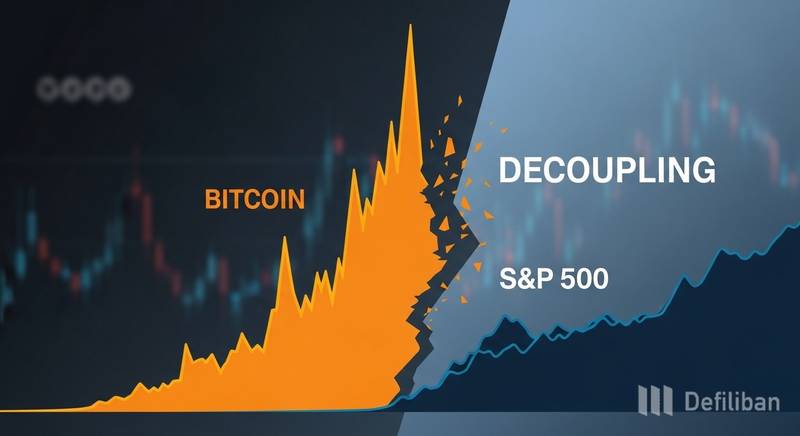
Bitcoin is experiencing its longest period of decoupling from the S&P 500 since 2020, a divergence that is reshaping how DeFi protocols assess wrapped BTC collateral risk and forcing a reassessment of crypto’s correlation with traditional equities.
The Bitcoin S&P 500 decoupling, first flagged by Bitcoin Magazine as a notable market signal, has drawn attention from on-chain analysts and macro strategists alike. The 20-day BTC/S&P 500 correlation coefficient plunged to approximately -0.5 during the recent bear phase before rebounding to around -0.10, a sustained breakdown not seen in over five years.
Market Divergence
Longest since 2020
Bitcoin’s correlation with the S&P 500 has broken down to its weakest level in over five years, underscoring crypto’s growing independence from traditional equity markets.
Correlation Collapse: What the Numbers Show
The divergence traces back to a massive liquidation event in October 2025 that wiped nearly 70,000 BTC in open interest in a single session. That cascade reset derivatives exposure to April 2025 levels, erasing six months of accumulated positions and severing the mechanical link between leveraged crypto positions and equity-correlated risk trades.
Over the last six months, the performance gap has been stark. The S&P 500 gained 7%, gold surged 51%, and Bitcoin fell 43%. BTC peaked near $124,500 in October 2025; it now trades around $84,000, still down more than 32% from that high.
The last comparable divergence occurred in early 2020, during the COVID-era dislocation, when BTC briefly traded as a standalone risk asset before institutional adoption through 2021-2022 tightened its correlation with equities. The current break is structurally different: spot Bitcoin ETF flows now provide a non-equity demand source that did not exist during previous cycles.
Historical Context
≈ 5 Years
The last time Bitcoin traded with this degree of independence from the S&P 500 was in 2020, before the institutional adoption wave tied crypto returns tightly to risk-on equities.
DeFi Collateral at a Crossroads: wBTC Flows Under Decoupling Stress
When BTC decouples from equities, it behaves less like a risk-on tech proxy and more like a standalone treasury asset. For DeFi lending protocols that rely on wrapped BTC (wBTC, cbBTC) as collateral, this shift changes the liquidation risk profile entirely.
During periods of tight BTC/equity correlation, a broad market selloff triggers simultaneous liquidations across both traditional and crypto positions. The October 2025 liquidation event, which resembled the kind of leveraged blowups that have plagued oversized BTC positions, demonstrated how quickly cascading liquidations can drain protocol collateral.
Under decoupling, that correlation-driven cascade risk diminishes. An equity selloff no longer mechanically triggers BTC collateral liquidations on Aave, Compound, or MakerDAO/Sky. However, the tradeoff is increased idiosyncratic BTC risk: protocol collateral now moves on crypto-native catalysts like exchange delistings, regulatory shocks, or whale redistribution events rather than broad macro signals.
DeFi total value locked declined by approximately $20 billion during the bear phase, reflecting both falling asset prices and active capital withdrawal. For protocols with significant wBTC collateral exposure, the question is whether risk parameters have been adjusted to reflect BTC’s new correlation regime. Collateral ratio thresholds calibrated for a correlated environment may understate risk in a decoupled one, where BTC can fall sharply even as equities hold steady.
The recent pattern of ETF inflows feeding DeFi liquidity adds a new variable. Spot ETF demand provides a structural floor for BTC that did not exist in previous decoupling episodes, potentially supporting wBTC collateral values even during crypto-specific drawdowns.
Analysts Split on Whether Decoupling Signals Maturation or Fragility
Market analyst Tony Severino offered a cautionary reading of the data. “Historically, when Bitcoin’s correlation with the S&P 500 drops to -0.5 and then turns sharply up, it is a warning sign that the stock market is going to collapse,” Severino noted.
Others see the divergence as a capital rotation opportunity. One analyst cited by AMBCrypto pointed to the late-2022 post-FTX decorrelation as precedent: “Similar decorrelation led to BTC doubling next year.”
The gold comparison complicates both narratives. Gold’s 51% gain over the same period that BTC fell 43% has become a focal point for critics of the “digital gold” thesis. As one observer put it: the 51% surge in gold while Bitcoin remains roughly 48% below its October peak “proves that ‘digital gold’ is failing its first major safe-haven test of 2026.”
Bitcoin dominance holds at 58.52%, suggesting that capital is not rotating into altcoins but rather leaving crypto entirely for traditional safe havens. The Crypto Fear & Greed Index hit 11 (Extreme Fear) on March 20, marking 46 consecutive days of extreme fear, the longest streak since late 2022. By March 22-23, it had recovered slightly to 26, still firmly in “Fear” territory.
On-Chain Counter-Signal: Redistribution, Not Panic
One underreported nuance in the data: on-chain analysis shows dormant coin reactivation during the drawdown, interpreted by some analysts as strategic redistribution rather than panic selling. If accurate, this suggests long-term holders are repositioning rather than capitulating, a pattern historically associated with accumulation phases.
This reading aligns with the concentrated whale behavior seen across crypto markets, where large holders often move counter to retail sentiment. The 46-day extreme fear streak, combined with dormant coin movement, creates a divergence between sentiment indicators and on-chain holder behavior that bears monitoring.
Protocol Risk If Correlation Snaps Back
Past decouplings have reversed. The 2020 divergence gave way to one of the tightest BTC/equity correlation periods in crypto history through 2021-2022. If BTC recouples sharply during a broader market downturn, over-leveraged DeFi positions in wBTC collateral face outsized liquidation risk, precisely because protocols may have relaxed their correlation assumptions during the decoupled period.
The October 2025 liquidation cascade, which wiped 70,000 BTC in open interest in a single session, demonstrated how quickly derivative-driven selling can overwhelm protocol buffers. DeFi governance teams on Aave and MakerDAO/Sky should be stress-testing collateral parameters against a recoupling scenario, not just the current decoupled regime.
For now, Bitcoin trades at approximately $84,000 with the Fear & Greed Index at 26. The decoupling from equities is real and measurable. Whether it represents crypto’s maturation into a standalone asset class or a temporary dislocation before the next correlation regime remains the defining question for DeFi risk management in Q2 2026.
Disclaimer: This article is for informational purposes only and does not constitute financial or investment advice. Cryptocurrency and digital asset markets carry significant risk. Always do your own research before making decisions.