


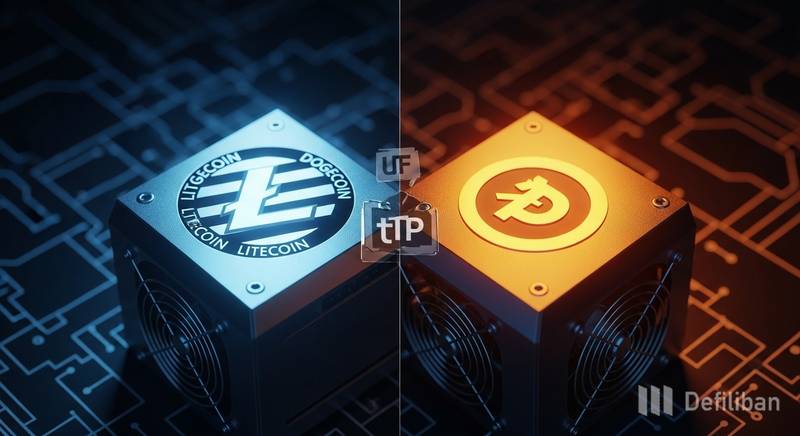
Bitdeer has taped out a new ASIC chip designed specifically for Litecoin and Dogecoin mining, with an accompanying miner planned for launch in Q1 2026. The SEAL-DL1 chip and its hardware counterpart, the SEALMINER-DL1, mark the company’s first move into Scrypt-based mining hardware, though key details around pricing, specifications, and commercial availability remain unconfirmed.
Key Takeaways
- Bitdeer confirmed it successfully taped out the SEAL-DL1 chip for LTC/DOGE mining, with initial test results that “exceeded expectations.”
- The SEALMINER-DL1 miner was slated for a Q1 2026 launch, but no product page, pricing, or shipping details have been publicly confirmed.
- No efficiency benchmarks or head-to-head comparisons with existing Scrypt miners are available yet.
What Bitdeer Confirmed About Its New LTC/DOGE Miner
In its January 2026 production and operations update, Bitdeer disclosed that it had successfully taped out a Litecoin-focused ASIC chip called the SEAL-DL1. The chip is designed for mining both Dogecoin and Litecoin, which share the Scrypt hashing algorithm.
Matt Kong, speaking on behalf of the company, said: “We have successfully tested our first LTC/Doge miner, the DL1, and its performance exceeded expectations.” The update also stated that Bitdeer planned to launch the SEALMINER-DL1, the full mining unit built around the SEAL-DL1 chip, during Q1 2026.
The distinction between SEAL-DL1 and SEALMINER-DL1 matters. The first refers to the ASIC chip itself; the second is the branded mining hardware product. A successful tape-out confirms the chip design has moved from testing into physical production, but it does not confirm that finished miners are shipping to customers.
Blockspace independently reported on the SEAL-DL1 tape-out, tying its reporting to the same January 2026 operations update. No additional sources have confirmed a completed commercial launch beyond the planned Q1 timeline.
Why a New Scrypt Miner Matters for Litecoin and Dogecoin Mining
Litecoin and Dogecoin both use the Scrypt proof-of-work algorithm, and the two networks support merged mining. That means a single piece of Scrypt hardware can mine both assets simultaneously, making any new entrant in this space relevant to both communities at once.
Bitdeer’s core business has historically centered on Bitcoin mining. The company reported 63.2 EH/s in self-mining hashrate and 65.1 EH/s in total proprietary hash rate deployed as of its January 2026 update, alongside 8.1 EH/s in cumulative external sales of its SEALMINER A2 units. All of those figures relate to Bitcoin, not Scrypt-based mining.
The SEAL-DL1 represents a deliberate expansion into a different mining ecosystem. For context, Bitdeer’s existing scale in chip design and manufacturing, demonstrated through its Bitcoin-focused SEALMINER line, suggests the company has the infrastructure to bring a Scrypt product to market. Whether it can compete on efficiency and price against established Scrypt ASIC manufacturers remains an open question, similar to how large-scale Bitcoin accumulation strategies raise questions about execution beyond stated intent.
No public efficiency ratings, power consumption figures, or hashrate-per-unit specifications have been released for the SEALMINER-DL1. Without those numbers, any comparison to existing Scrypt miners from competitors like Bitmain would be speculative.
What Is Still Missing Before Miners Can Assess SEALMINER-DL1
The research supporting this story turned up several gaps that prospective buyers and industry watchers should note before treating the SEALMINER-DL1 as a confirmed market entrant.
No official Bitdeer product page or sales listing for the SEALMINER-DL1 has been found. There is no public pricing, no detailed specification sheet, no shipment timeline, and no customer deployment announcement. The January 2026 operations update remains the most recent official source.
The Proof Points Still Needed
- Hashrate and efficiency: No Scrypt hashrate rating (MH/s or GH/s) or joules-per-megahash figure has been published.
- Price and availability: No retail or wholesale pricing has been disclosed, and no pre-order or order page exists.
- Shipping and deployment: No confirmed shipment dates or customer deployment reports have surfaced.
- Third-party benchmarks: No independent testing or reviews of the SEALMINER-DL1 have been published.
The Q1 2026 launch window cited in the original update runs through the end of March. If Bitdeer confirms commercial availability with specs and pricing within that window, the story shifts from a development milestone to a competitive market entry. That confirmation, paired with verifiable performance data, would allow direct comparison against existing Scrypt hardware and give miners tracking capital flows in the broader crypto mining sector a concrete new variable to evaluate.
Until then, the verified takeaway is narrower: Bitdeer has built and tested a new Scrypt chip, it exceeded internal expectations, and the company intends to ship a miner built around it. That is a meaningful step for a company of Bitdeer’s scale, but it is not yet a product miners can buy.
Disclaimer: This article is for informational purposes only and does not constitute financial or investment advice. Cryptocurrency and digital asset markets carry significant risk. Always do your own research before making decisions.