



<!DOCTYPE html>
Bitcoin Price-Open Interest Divergence: Does Weak Positioning Point to More Downside?
Bitcoin is trading in a market that looks cautious rather than fully committed. Recent pricing data in the research brief put BTC near $74,258, while CoinGlass showed Bitcoin open interest around $43.52 billion. That matters because open interest, the total value of outstanding futures and perpetual contracts, is one of the clearest ways to judge whether leverage is returning alongside price.
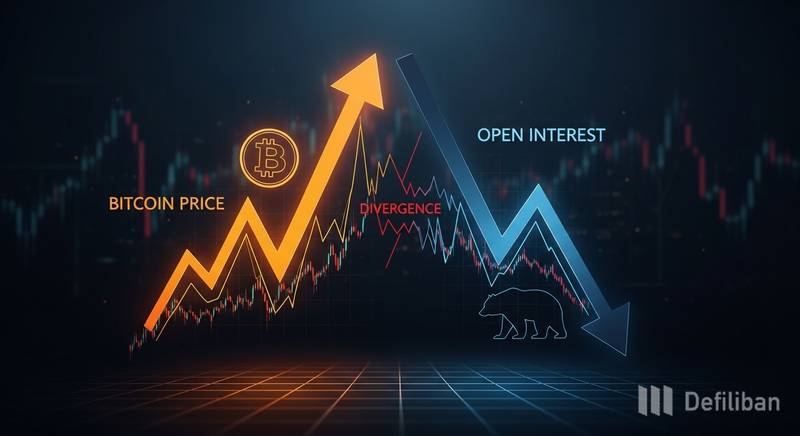
When price rises or stabilizes but open interest stays muted, traders often describe it as a price-open interest divergence. In simple terms, spot demand may be holding up better than speculative conviction. That can be a warning sign because rallies without fresh positioning can struggle to extend, especially if sellers regain control. Still, it is important to keep the claim in proportion: divergence is a signal, not confirmation of a fresh leg down.
Why the Bitcoin Price-Open Interest Divergence Matters Now
The main reason this setup is drawing attention is that leverage has not rebuilt in a convincing way. The embedded research notes subdued derivatives participation even as Bitcoin remains a closely watched macro and crypto bellwether. CoinGlass also listed futures volume near $71.17 billion, but volume alone does not mean traders are leaning aggressively bullish. Open interest is more useful here because it helps distinguish between active trading and actual expansion in market exposure.
If BTC were moving higher with a steady rise in open interest, that would usually suggest new money and fresh directional commitment are entering the market. When that does not happen, the interpretation shifts. It may mean traders are using strength to reduce risk, that new longs are hesitant to chase, or that demand is being driven more by rotation in spot markets than by conviction in derivatives. In a market as cross-wired as Bitcoin, where price discovery now spans ETFs, CME futures, and offshore perpetuals, that hesitation can leave price vulnerable if momentum fades.
The caveat is just as important as the signal. Weak open interest does not automatically equal imminent downside. In some cases, a leverage reset can improve market structure by removing excess speculation and lowering liquidation risk. Readers following broader Bitcoin market structure may also want to compare this derivatives reset with longer-cycle themes such as Bitcoin Mining Rewards and the SEC Protocol Mining View, where policy and issuance narratives can matter as much as positioning.
What Current BTC Market Data Says About Downside Risk
The present evidence supports caution more than conviction. The brief cites a Fear and Greed reading of 26, a level classified as Fear, and summarizes derivatives commentary as cautious but not uniformly bearish. That distinction matters. A fearful market can create sharper downside moves because traders are quicker to de-risk, but it can also produce rebounds if selling pressure has already cleared out weak hands.
There is also a difference between deleveraging and aggressive short positioning. Deleveraging means leveraged longs and speculative exposure are being reduced. That can happen after volatility spikes, liquidations, or a broader risk reset. Aggressive short positioning, by contrast, would mean traders are actively building bearish exposure and pressing for lower prices. The evidence in this research package does not prove the second case. In fact, a recent Cointelegraph market summary framed a major open-interest decline as a market reset that could eventually support a stronger recovery rather than guarantee immediate downside.
That is why the cleanest takeaway is narrower than the original headline implies. Bitcoin’s current structure does suggest that bullish positioning is not especially strong, and that leaves the asset more exposed if price loses support. But the same data set does not conclusively show that traders are leaning heavily bearish. Markets often become dangerous when sentiment is fragile and conviction is thin, not necessarily when everyone is already short.
That broader uncertainty is also showing up across adjacent crypto narratives. On the policy side, traders are still weighing how regulation could shape market trust and liquidity, a theme that overlaps with CFTC Chair Says DeFi and Prediction Markets Could Restore Trust. On the macro side, institutional forecasts such as Citigroup Cuts Bitcoin to $112K and Ethereum to $3,175 on U.S. Crypto Law Delays show how quickly sentiment can swing when policy expectations change.
Key Levels and Signals Traders Should Watch Next
The next step is confirmation. If Bitcoin slips and open interest starts rising at the same time, that would strengthen the downside thesis because it could suggest fresh short exposure is entering the market. If both price and open interest fall together, the move may still look more like continued deleveraging than a fully directional bearish campaign. On the other hand, if price holds firm and open interest begins to rebuild, the current divergence would weaken and the market could regain a healthier bullish structure.
Secondary indicators matter here as well. Funding rates can help show whether perpetual traders are leaning too aggressively long or short. Spot and futures volume can reveal whether a move has real participation behind it. Liquidation clusters are also worth watching because thin conviction can turn relatively small moves into fast cascades. None of those checks are available in enough depth in this brief to settle the argument on their own, which is why a hard bearish call would go beyond the evidence.
For now, the practical conclusion is straightforward: Bitcoin’s price-open interest divergence points to a market that remains fragile, and that keeps downside risk on the table. What it does not yet do is prove that another breakdown is the most likely next move. Traders should watch whether leverage rebuilds with price, whether fear deepens into outright bearish positioning, and whether cross-market participation starts to confirm the next direction.
Author: Oliver Benjamin
Disclaimer: This article is for informational purposes only and does not constitute financial or investment advice. Cryptocurrency and digital asset markets carry significant risk. Always do your own research before making decisions.