


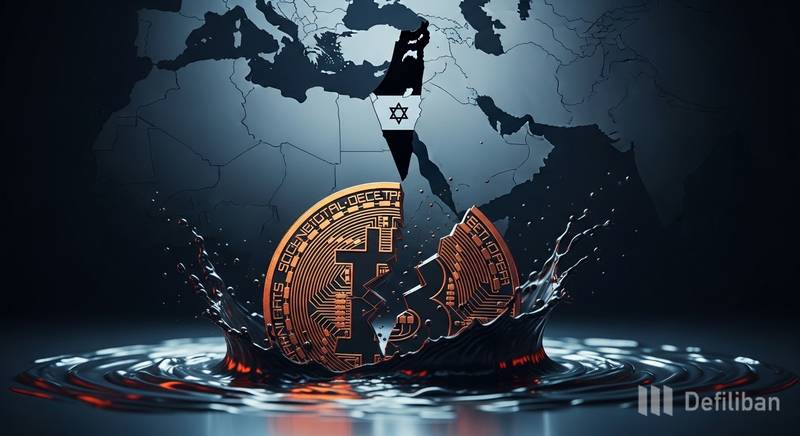
Israel’s public vow to continue military strikes on Iran has sent shockwaves through crypto markets, with Bitcoin swinging nearly $4,000 in a single session on March 23 and DeFi protocols absorbing $62.4 million in tokenized commodity liquidations. For DeFi participants, the escalation is not just a macro headline; it is a live stress test of on-chain liquidity, collateral health, and protocol risk parameters.
24-Hour Top Story · Engagement Snapshot
Israel Vows to Keep Attacking Iran
Geopolitical escalation in the Middle East is a key macro risk factor for crypto market volatility.
Middle East Escalation Triggers Risk-Off Rotation Across DeFi Protocols
On Day 24 of Operation Epic Fury, which began February 28 with the killing of Supreme Leader Khamenei, Israel publicly declared its intention to sustain military operations against Iran. Iranian state media, including the Mehr news agency and the Foreign Ministry, denied that any negotiations or discussions have taken place with the United States since the war began.
That diplomatic void is what matters for DeFi. Trump claimed on March 23 that “very good and productive conversations” were underway toward a “complete and total resolution.” Hours later, Iran’s Fars news agency flatly contradicted him, stating no talks had occurred and that Trump’s comments were aimed at reducing energy prices.
Bitcoin captured the whiplash in real time. The price surged from $68,150 on March 22 to $71,200 intraday on March 23, a 5.4% spike, before retreating toward $70,000 after Iran’s denial. That kind of collateral-value volatility directly impacts DeFi borrowers.
When BTC and ETH swing 5% in hours, health factors on lending protocols like Aave and Compound compress. Borrowers holding volatile collateral face tighter margins, and historical patterns from prior Israel-Iran escalations in April and October 2024 show short-term TVL contractions on Ethereum-based lending protocols as users de-lever preemptively.
The broader macro backdrop reinforces the risk-off signal. WTI crude fell 11% below $88 per barrel, Brent dropped 8% to roughly $100, the U.S. 10-year yield fell 100 basis points to 4.3%, and the DXY slipped to 99.3. These are not isolated moves; they represent a coordinated flight from risk that spills directly into on-chain collateral valuations.
The most concrete DeFi-specific damage came from Hyperliquid, where $62.4 million in liquidations hit tokenized Brent crude futures markets on March 23. That figure illustrates something most crypto outlets have underreported: the geopolitical-to-DeFi transmission mechanism runs through tokenized commodities, not just BTC price.
For context, the initial strike weekend on February 28 triggered over $300 million in total crypto liquidations, establishing a pattern of conflict-driven forced selling that DeFi protocols are still absorbing weeks later.
Stablecoin Flows and Protocol Liquidity as a Geopolitical Hedge
When geopolitical uncertainty spikes, DeFi capital does not leave the ecosystem. It rotates into stablecoins. USDC, USDT, and DAI historically see inflow surges during Middle East conflict escalations as traders park capital in non-volatile assets without exiting to fiat.
This behavior creates a distinctive pattern in protocol metrics. Stablecoin pool utilization on Curve Finance and Aave’s stablecoin markets tends to rise during macro shocks, as more capital flows into lending pools while borrowing demand from leveraged traders simultaneously increases.
The yield implications are direct. Higher stablecoin utilization means higher borrow APYs, which in turn means better returns for stablecoin liquidity providers. For DeFi-native participants, a geopolitical crisis is not just a risk event; it is a yield event in stablecoin markets.
Iran’s denial of any diplomatic contact suggests this is not resolving soon. Sustained uncertainty favors prolonged stablecoin allocation in DeFi vaults over volatile collateral positions. The Fear and Greed Index sits at 10, deep in Extreme Fear territory, now on a 46-day streak that is the longest since the FTX collapse.
Cross-chain liquidity fragmentation also becomes more visible during risk-off periods. As capital consolidates into perceived safe-haven protocols, the distribution of stablecoin supply between Ethereum mainnet and L2s shifts. Monitoring where stablecoins concentrate, whether on mainnet Aave or L2 lending markets, reveals which venues the market trusts during stress.
MicroStrategy’s continued accumulation provides a contrarian data point. An SEC filing confirmed the company purchased 1,031 BTC for $76.6 million between March 16 and 22, even as the Fear and Greed Index signaled extreme risk aversion. Institutional inflow patterns during wartime diverge sharply from retail sentiment.
On-Chain Signals to Watch as the Conflict Develops
DeFi participants tracking this situation should focus on a specific set of protocol-level metrics rather than headline news flow.
Liquidation volume on Aave and Compound is the most direct measure of forced de-leveraging. A spike in liquidation events, particularly in ETH and wBTC collateral markets, signals that the collateral-value compression from BTC volatility is translating into real protocol stress.
Health factor distribution among whale wallets on Ethereum lending protocols indicates how close large positions are to liquidation thresholds. Concentrated risk in a handful of wallets can trigger cascading liquidations if BTC revisits the $67,500 level it touched before the March 23 surge.
Perpetual funding rates on DeFi platforms like dYdX and GMX serve as a real-time sentiment proxy. Negative funding rates indicate bearish positioning dominates, while a flip to positive signals speculative appetite returning. Given that crypto platforms dominated Iran-war trading during weekend hours when equity markets were closed, these DeFi-native perp venues carry outsized signaling value.
Governance activity is the slowest-moving but most consequential signal. If protocol governance teams begin submitting emergency risk parameter proposals, adjusting collateral factors, or reviewing liquidation thresholds, it indicates the conflict’s market impact has reached a severity that requires structural protocol response. The evolution of DeFi perpetual platforms toward more sophisticated risk controls will be tested in real time.
The total crypto market cap stands at approximately $2.43 trillion with BTC dominance at 56.2%. Bitcoin remains roughly 46% below its October 2025 all-time high of $126,296. Whale accumulation of 53,000 BTC continues even as exchange reserves hit seven-year lows, a divergence that suggests large holders are positioning for a resolution rally while retail exits.
Two scenarios frame the near-term outlook. If Israel-Iran hostilities remain at current intensity, expect continued stablecoin rotation, elevated liquidation risk on leveraged DeFi positions, and compressed but positive yields on stablecoin lending. If the conflict escalates beyond current parameters, the $300 million liquidation event from the initial strike weekend becomes the floor, not the ceiling, for potential forced selling across DeFi protocols.
Disclaimer: This article is for informational purposes only and does not constitute financial or investment advice. Cryptocurrency and digital asset markets carry significant risk. Always do your own research before making decisions.