


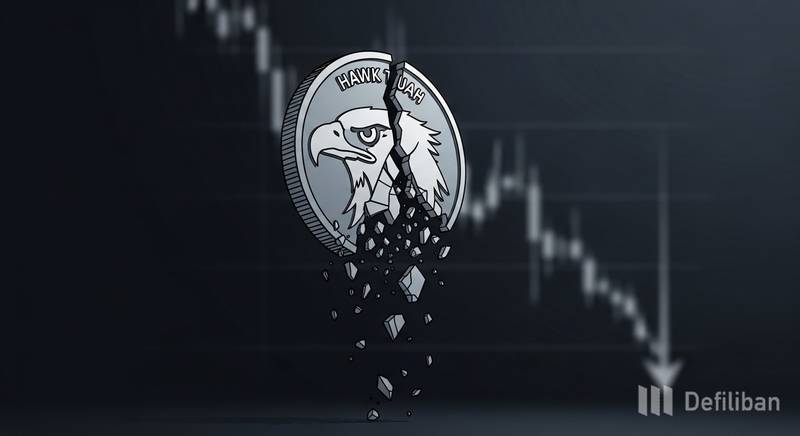
Haliey Welch, the viral internet personality known as the “Hawk Tuah” girl, broke her silence after her $HAWK meme coin crashed roughly 90% from a peak market capitalization near $490 million, leaving investors facing steep losses and a class action lawsuit filed in federal court.
The $HAWK token launched on December 4, 2024 at 22:00 UTC on the Solana blockchain. Within hours, the token surged to a market capitalization between $490 million and $500 million before collapsing by approximately 91%, wiping out the bulk of its value in a single trading session.
A pre-sale conducted before the public launch had raised approximately $2.8 million at a valuation of about $16.69 million, according to the complaint filed by Wolf Popper LLP and Burwick Law. The gap between that pre-sale valuation and the token’s brief peak raised immediate questions about insider allocation and the mechanics of the launch.
The token has since collapsed further. Current tracking data on DexScreener shows the HAWK/SOL pair on Solana with effectively no remaining liquidity and a market cap near $9, signaling the token is now largely inactive.
Welch Said She Is “Fully Cooperating” With Legal Teams
On December 20, 2024, Welch posted a statement on X addressing the fallout. She said she was “fully cooperating with and committed to assisting the legal team representing the individuals impacted.” The statement came the same day that the class action lawsuit was filed.
The response stopped short of explaining why the token collapsed or addressing allegations of insider manipulation that had spread across social media. Welch did not defend the token’s performance or distance herself from the project in the statement reviewed by multiple outlets.
For holders who had watched the token lose over 90% of its value in hours, the statement offered limited reassurance. The phrasing suggested awareness of legal exposure but left open questions about her direct involvement in the token’s structure and promotion.
Class Action Filed Over Alleged Securities Violations
On December 20, 2024, law firms Wolf Popper LLP and Burwick Law announced they had filed a class action lawsuit over the $HAWK token in the U.S. District Court for the Eastern District of New York. The complaint alleges that $HAWK was promoted as a meme coin associated with Welch and that purchasers suffered damages when the token’s price declined steeply.
The filing alleges violations of Sections 5 and 12(a)(1) of the Securities Act, claiming $HAWK was sold and promoted as an unregistered security. The complaint names project-linked entities and individuals, though reporting reviewed for this article did not list Welch herself as a named defendant.
The legal action adds $HAWK to a growing list of celebrity-linked crypto tokens that have drawn regulatory and legal scrutiny. Investors who lost money in similar token launches where promotional claims outpaced legal compliance have increasingly turned to civil litigation as an avenue for recovery.
What the Crash Signals for Meme Coin Traders
The $HAWK collapse follows a familiar pattern in celebrity-backed meme tokens: rapid hype-driven price inflation followed by an equally rapid selloff that concentrates losses among retail buyers. Social reaction to the crash was overwhelmingly negative, centered on rug-pull allegations and concerns about insider wallets.
The speed of the collapse, from a $490 million market cap to a 90% drawdown within hours, underscores the acute volatility risk embedded in meme coins with no underlying protocol utility. Traders chasing momentum in hype-driven launches face a structural disadvantage when pre-sale holders and insiders can exit at peak valuations.
The reputational risk cuts both ways. Celebrity promoters face potential legal liability, as the $HAWK lawsuit demonstrates. And for the broader meme coin sector, each high-profile implosion erodes the credibility that sustains buyer interest in the next launch.
For crypto traders tracking daily market developments, the $HAWK episode serves as a concrete case study in what can go wrong when speculative tokens rely entirely on personality-driven demand with no transparent tokenomics or accountability structure.
The lawsuit remains in its early stages, and no court rulings have been issued. Whether the case results in recovery for investors or sets a broader precedent for celebrity token liability will depend on how courts apply existing securities law to meme coin launches built on social media influence.
Disclaimer: This article is for informational purposes only and does not constitute financial or investment advice. Cryptocurrency and digital asset markets carry significant risk. Always do your own research before making decisions.